Blog post – European Conference on Sustainable Tourism
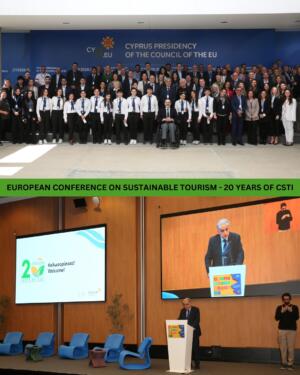
On February 27, the CEF team and I had the opportunity to participate in the European Conference on Sustainable Tourism, organised by the Cyprus Sustainable Tourism Initiative (CSTI), which is celebrating its 20-year anniversary under the auspices of the Presidency of Cyprus of the European Union.
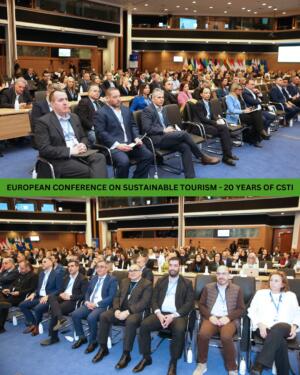
It was inspiring to see so many people gathered to openly discuss the environmental and social challenges associated with Cyprus’ largest industry. Tourism is often a highly extractive sector — placing pressure on land, water, food systems and local communities. Seeing these conversations taking place here in Cyprus gives people like me real hope that meaningful change is possible.
One of the speakers, Jeremy Sampson, CEO of The Travel Foundation, stated that “the tourism system we have is not fit for the climate reality.” This is a powerful and urgent message — especially for a country like Cyprus.
Cyprus is already experiencing rising temperatures, prolonged droughts and increasing water scarcity. Tourism, particularly during peak summer months, intensifies water demand at the exact time when resources are most limited. Hotels, swimming pools, golf courses and imported food systems all add pressure to fragile ecosystems. As climate change accelerates, extreme heat could reduce the attractiveness of summer travel, increase energy demand for cooling, and place additional strain on infrastructure.
Food security is another emerging challenge. Cyprus imports a large percentage of its food, making the tourism sector vulnerable to global supply chain disruptions and climate-related crop failures elsewhere. At the same time, local agricultural land faces desertification and soil degradation. Without regenerative land practices, the island risks losing both biodiversity and productive capacity.
And perhaps most importantly, the natural beauty that attracts visitors — pristine beaches, marine life, forests and rural landscapes — is under threat from biodiversity loss, wildfires and overdevelopment. If we continue on a purely extractive path, tourism risks undermining the very assets it depends on.
What emerged clearly from the conference — and what many in the climate and environmental space have been saying for years — is that sustainability is no longer enough. Sustainability aims to maintain resources for the next generation. But in many respects, we have already overshot planetary limits. The conversation must now shift toward regeneration.
Regeneration goes beyond “doing less harm.” It means actively restoring ecosystems, rebuilding soil health, protecting biodiversity and strengthening local communities. It means putting resources back into nature and allowing time for recovery. Tourism, if reimagined, can play a crucial role in this transition.
At CEF, we see this potential firsthand. Through initiatives such as the TUI Field to Fork Cyprus project, we use tourism to promote regenerative agriculture and reconnect visitors with local food systems. Through the Fish the Alien initiative, we contribute to restoring marine ecosystems and supporting endangered species populations. These are practical examples of how tourism can move from extraction to regeneration.
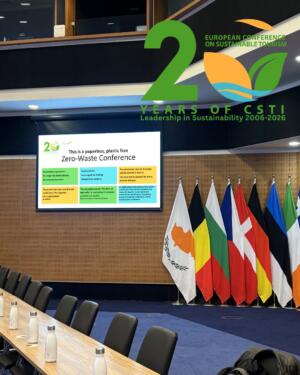
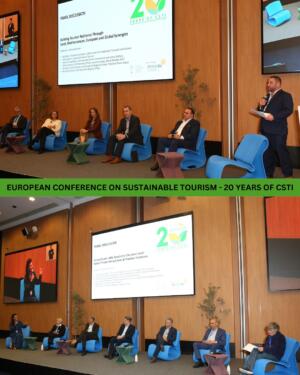
Another aspect of the conference that truly stood out was CSTI’s commitment to organising a genuinely environmentally responsible event. There were no single-use plastics or disposable cups. The chairs used by the panelists were made from plastics recovered during beach cleanups. Catering was based on locally sourced ingredients, served in smaller portions to reduce food waste and lower the overall carbon footprint.
This demonstrates that environmentally conscious choices are possible — when there is intention, planning and genuine commitment. It shows that change does not only happen at policy level, but also through everyday decisions.
Thank you, CSTI, for a wonderful conference and for the incredible work you have been doing in Cyprus over the past 20 years. Conversations like these matter — and they give us hope that tourism in Cyprus can evolve into a force for regeneration rather than depletion.
Panayiotis Louca
Project Manager, CEF
Photos by CSTI